He did a great job explaining and demonstrating the perfect tool for fitting complex shapes. Thanks for sharing.
For areas with less irregularity, straight lines and fair curves, this (
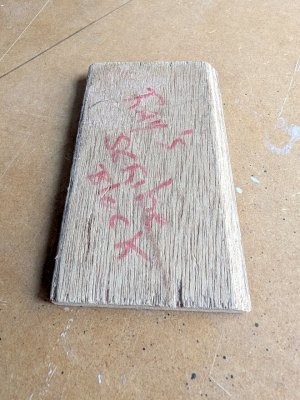
or a version) has been my scribe tool for the past 40+ years.
I started out in the boatbuilding trades as an interior joiner - fishing boats and yachts. We were constantly scribing to make sheet goods or boards fit into complex shapes. Even the boards that make up the hull of some boats or ships are scribed (
in that application its called spiling) Decking (
the word for boat floors) ceilings (
the word for boat walls) all required big areas to be scribed in when fitting with sheet material. The heads (
boat bathrooms) on the yachts we built were most often entirely lined with formica as that little room was also the shower. These panels needed to be as seamless (
one piece per section) as possible. With curved ceilings (
imagine the shape of a section of a hull - the outside wall) merging into a flat vertical bulkhead (
the boat walls that are perpendicular to the center line). These were some complex shapes.
With my 3/8" thick x 3" to 4" x 2" to 3" scribe block I got to be able to fit the flexible, though very brittle Formica (
especially in the winter shop temps usually around 50°) with cardboard as my trace template, with great accuracy. We used to keep 40 or 50 sheets of 4x8 - 2 ply cardboard sheets in stock, particularly for this purpose. But this works well for even small areas that need a precise fit before using the expensive finish materials.
Cut the cardboard roughly to within a 1/2" up to just under the max width or length of your block. Tape the cardboard (
or weight or clamp it down) securely into your space leaving a margin all around the perimeter. If you have a good straight edge in the mix you can simply set one straight edge of the cardboard against a straight edge of the templating area. The rest is simply running your block around the perimeter and marking your pencil line
(hash marks or full length lines) off the inside edge (
away from the edge you are fitting too) along your scribe block. Using the same principal as in the video you will then transfer your marks off the cardboard onto your finished surface. This will reveal any out of squareness of your fit area accurately. At radiuses I just make a bunch of hash marks
(short straight lines) that when transferring to cardboard give you points to connect to with a batten or plastic - ship or French curves (
these come in sets). You can easily transfer lines with your scribe block around obstacles - a glob of weld, or a glue block or whatever. I also make notes as I go if something needs to be noted, for example, a pipe hole dia. or an irregularity that doesn't lend itself to an easy trace. The angle cut along one edge of my block ensures that I can get my pencil point directly transferred without having it veer out of vertical. I too use a flashlight occasionally to transfer a mark amidst shadows.
The TICK STICK is more of a specialty tool for complex shapes but occasionally it is the ESSENTIAL tool. Otherwise, I use the scribe block often for all kinds of projects that many of you (
pros and DIY alike) might encounter.
I hope my how-to is easy to follow. Sorry if it's not.

Maybe you can use a scribe block or a tick stick to sort it out.